Progress to Date
-
1994 - 1998
Mark captained Dublin University Boat Club, rowed for Ireland, and had a job offer waiting in London. Life was on track.
-
1998
In his final year at Trinity College Dublin, Mark suddenly lost his sight, weeks before his final exams: the first unexpected challenge that he had to decide how to respond to.
-
2002
Four years after losing his sight, Mark returned to the boat, winning silver and bronze at the Commonwealth Rowing Championships for Northern Ireland.
-
2003
Unbroken by blindness, Mark became an adventure athlete, racing across deserts, mountains, and polar ice caps. It started with six marathons in seven days across the Gobi Desert, and continued to the North Pole Marathon, Dead Sea Ultra, Everest Marathon, Zurich Ironman, and Round Ireland Yacht Race.
-
2009
The ultimate test came in the race to the South Pole, alongside teammates Simon O'Donnell and Inge Solheim. Over 43 days, in temperatures as low as minus 50 degrees, Mark became the first blind person to do it.
-
2010
In June 2010, sailing with Mick Liddy, Mark became the first blind person to co-skipper a boat in the 1,400 mile Round Ireland Yacht Race. Weeks later, everything changed. Four weeks before Mark and Simone George were due to marry, a fall from a second-storey window nearly killed him. Paralysis was added to blindness
-
2011
After 16 months in hospital, Mark committed his paralysed body to experimental research, exploring the intersection where humans and technology collide. Mark founded Run in the Dark. Each November until 2024, more than 250,000 people in 50 cities ran wearing red flashing armbands to raise funds to cure paralysis.
-
2012
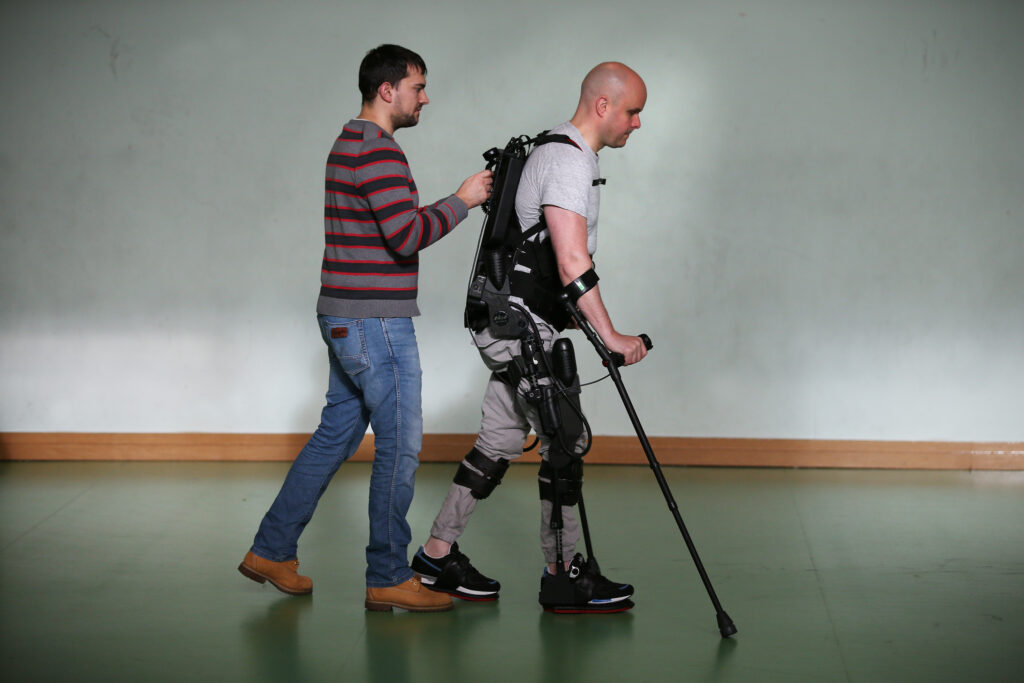
Mark took his first robotic steps in an Ekso Bionics exoskeleton in San Francisco, going on to become its leading test pilot and take over 1.5 million steps. Mark was selected as one of the first ambassadors for Wings for Life, the global foundation funding research to cure spinal cord injury.
-
2013
At UCLA, Mark combined spinal cord stimulation with walking in a robotic exoskeleton for the first time, voluntarily moving his leg again. The work continues at Trinity College Dublin today. Mark joined the board of the Christopher and Dana Reeve Foundation in the United States, serving for a decade alongside its work to cure spinal cord injury.
-
2014
Mark's story was captured in "Unbreakable - The Mark Pollock Story", an award-winning documentary six years in the making, following Mark and Simone George through blindness, injury, and the search for a cure.
-
2016
Using transcutaneous spinal stimulation, Mark stood independently, a moment captured in The Space Between Skeleton and Skin, an award-winning Newstalk radio documentary made with Jonathan McCrea. Mark put curing paralysis on the world stage at the World Economic Forum's Annual Meeting in Davos, speaking on the human dimension of the fourth industrial revolution, and joined the WEF's Global Futures Council on Human Enhancement.
-
2018
Mark and Simone George took the TED stage together, speaking about the tension between acceptance and hope, and catalysing collaborations to cure paralysis.
-
2019
With multiple partners, Mark launched the Exoskeleton Access Programme at Dublin City University, giving people living with paralysis, stroke, and MS affordable access to robotic walking.
-
2020
Mark founded Collaborative Cures, which he chairs, to bring together the scientists, technologists, and investors needed to cure paralysis in our lifetime.
-
2023
It started with Mark's election to the WEF's Forum of Young Global Leaders a decade earlier. The relationships he and Simone built through that network have catalysed collaborations worth over $150 million in neurotech projects to cure paralysis.
-
2026
Now pursuing a Professional Doctorate in Elite Performance at Dublin City University, Mark is testing his Unbreakable Framework to understand why, when the challenge chooses them, some people sit on the sidelines while others step into the arena. Mark continues to train, combining adapted CrossFit with walking in his Ekso Bionics exoskeleton and using a spinal cord stimulator that has moved from experimental research to commercially available technology.